A recent report by the Health Service Journal has revealed the £2bn cost of delayed discharges. This is an area in which Develop Consulting has a strong track record of working with healthcare organisations to improve flow, patient management, length of stay (LOS) reduction and discharge planning.
The major contributor to this cost is what’s known as Bed Occupancy Beyond Medical Need. NHS England estimates that in September alone, there were 390,960 bed days attributed to patients who were medically fit to leave but remained in hospital. With an average cost of £562 per bed day, this equates to £220 million per month, or over £2.6 billion annually.

This problem has existed for a number of years and is fundamentally a system problem, requiring providers to work beyond the back door of the hospital and into the community.
Our team worked extensively with University College London Hospitals NHS Foundation Trust on a hospital discharge process redesign through their ‘Home For Lunch’ programme to facilitate morning discharges. Working with staff from multiple departments, the project coordinated and managed discharge planning far more effectively. Tasks were coordinated, patients, families and transport mobilised, along with other professional services to ensure take-home drugs and documentation were all ready. The impact for staff, patients and families was huge.
Setting a target of 11am for all discharges freed up beds and created capacity. This thinking is common in hotels, so Develop Consulting adopted a similar approach for the NHS, which became known as ‘Home for Lunch’.
At Sandwell & West Birmingham Hospital NHS Trust, the team developed a ‘patient flow bundle’ which included a patient tracking system combined with a daily problem-solving approach. This resulted in reduced discharge delays, improved patient satisfaction and a major reduction in taxi spend for transportation of patients.
Updating a live status tracker by ward and by patient created a system that managed patients to a planned discharge date, which was central to coordinating people and processes. Key interventions included setting an expected date of discharge (EDD) upon a patient’s admission, aligning the multi-disciplinary team towards a single, shared goal.
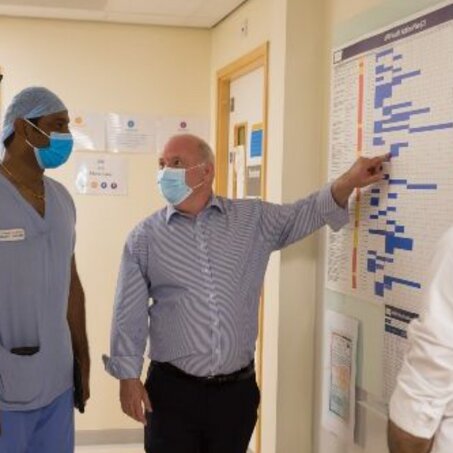
Regular daily multi-disciplinary team (MDT) meetings, called “SitReps” (Situation Reports), allowed teams to review every patient’s progress. This helped address potential delays and roadblocks proactively, with meetings held around the Ward Boards.
Time-consuming administrative tasks for clinical staff were streamlined using SBAR, freeing up time for patient care. Pharmacy teams were engaged to prioritise ward patient discharge summaries and medications.
More effective use of the discharge lounge moved patients out of beds as soon as they were medically ready, whilst they awaited final transportation or medication. This allowed staff to prepare beds for new patients without delay.
Consistent working practices and decision-making were implemented across wards through daily huddles, updating ward boards and MDT meetings to reduce variability.
Part of the ongoing concern is that some patients, despite being medically fit, don’t have a departure plan due to capacity beyond the hospital (step-down care, community services, care homes). The most significant cause of delayed discharges is the lack of available social care packages, including home support, rehabilitation services, or care home placements. Without these, patients cannot safely leave hospital. The NHS 10-year plan and focus on community care and neighbourhoods has to address these shortages to enable improved flow and better discharge planning from secondary care and hospitals.
At Windsor Regional Hospital in Ontario, Canada, Develop Consulting helped to increase, from 32% to 70%, the proportion of planned discharges taking place by 11am.
Tackling the discharge challenge requires system-wide thinking, practical interventions and collaborative working across hospital and community services.
If your organisation is facing similar challenges with patient flow and discharge delays, get in touch to discuss how we can help.
By Steve Boam, CEO of Develop Consulting